
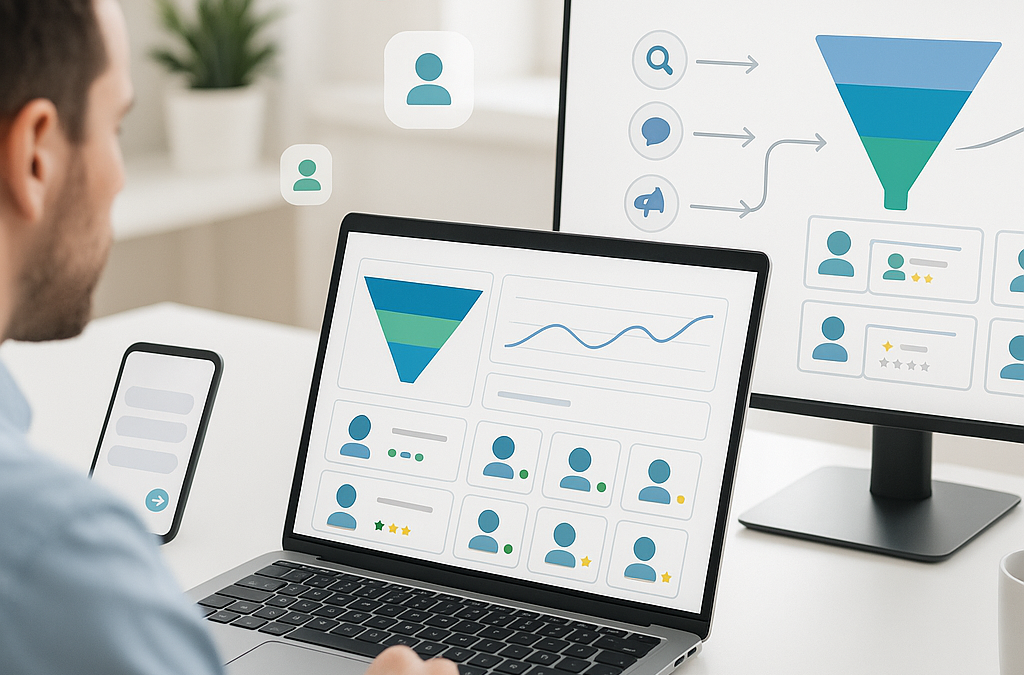
Why Digital Lead Gen Is Essential for Modern B2B Growth
Quick Answer
Digital lead generation is the process of attracting and capturing qualified buyer interest through online channels – search, content, paid media, email, and social – rather than depending on cold outreach or referrals alone. It produces measurable, scalable pipeline independent of any single relationship or sales rep. For B2B companies, it transforms existing expertise and credibility into a system that generates pipeline continuously.
Key Takeaways
- Referral dependency is a liability. Digital lead gen replaces unpredictable word-of-mouth with a measurable, repeatable pipeline you control.
- Systems beat tactics. The most effective B2B programs integrate SEO-driven content, conversion-optimized landing pages, and a structured nurture path, not isolated one-off efforts.
- ICP clarity drives quality. A system built around your ideal customer profile produces better-fit leads than one optimized for raw traffic volume.
- Campaigns fail; systems compound. Treating digital lead gen as a campaign is the single most common reason B2B companies see no lasting results.
- Measurement is non-negotiable. If you cannot trace a lead from channel to closed revenue using tools like HubSpot, Salesforce, or GA4, you cannot optimize what works or cut what doesn’t.
- Legal compliance is operational. GDPR, CAN-SPAM, and TCPA requirements apply to every lead capture and nurture sequence you run.
- Budget is not the differentiator. The companies that win have the clearest audience definition and the most consistent content engine, not the largest spend.
Digital lead gen is the structural upgrade most B2B businesses need but rarely build correctly. If your pipeline depends on referrals from a handful of key relationships, a trade show circuit that may or may not produce, or a sales team cold-calling into lists, you already know the problem: growth is unpredictable, effort is high, and the moment one variable changes – a rep leaves, a referral source goes quiet, a conference gets cancelled – revenue stalls. The shift to digital lead generation is about building a growth engine that works whether or not your best salesperson shows up on Monday. When your content ranks in search, your paid campaigns target the right decision-makers, and your nurture sequences qualify intent automatically, your pipeline becomes a system rather than a gamble. This article breaks down exactly why digital lead gen is structurally superior to traditional approaches, addresses the real reasons B2B companies have tried it and failed, and gives you a clear framework for building it right. Whether you are a founder evaluating your first real digital investment or a marketing leader rebuilding after a disappointing agency experience, what follows is a senior strategist’s brief, not a glossary entry.
Why the Old Lead Generation Playbook Is Breaking Down
Traditional lead generation methods are structurally fragile for B2B companies that want predictable, scalable growth. B2B companies that depend on referrals, trade shows, and cold outreach are not just leaving growth on the table – they are building a business that cannot scale without heroic individual effort. When your best salesperson leaves or your strongest referral source goes quiet, the pipeline dries up. That is a structural problem, not a personnel one.
B2B buyers now conduct significant independent research before engaging any vendor. By the time a prospect agrees to a sales conversation, the decision is often already well advanced, shaped by search results, content they consumed, and the credibility signals your digital presence either did or did not send.
Most B2B leaders understand digital lead gen conceptually. The breakdown happens at the system level. They run a campaign, see inconsistent results, and conclude it does not work for their industry. What actually failed was the architecture: disconnected tactics with no unified nurture path, no measurement framework, and no feedback loop.
Understanding why the old playbook fails is the first step. The next is understanding exactly what a well-built digital system delivers that traditional methods structurally cannot, starting with the ability to measure everything. For the mechanical how-to alongside the strategic why, see how digital marketing drives lead generation.
Reason 1: It Makes Your Pipeline Measurable, Not Just Hopeful
Digital lead gen transforms your pipeline from a relationship-dependent guessing game into a measurable system where every channel, asset, and touchpoint can be evaluated against real revenue outcomes. Something no referral program or cold call list can offer.
With traditional approaches, you close a deal and ask yourself: was it the trade show last spring, the cold email sequence, or the introduction from a mutual contact? You genuinely do not know. That means you cannot replicate it, you cannot scale it, and you cannot cut what is wasting budget. You are optimizing on instinct.
A functioning digital lead gen system is built on a specific measurement architecture:
- UTM parameters on every traffic source – paid ads, email campaigns, LinkedIn posts – so GA4 can attribute sessions and conversions to the exact origin
- Google Analytics 4 (GA4) configured with conversion events tied to real lead actions: form submissions, demo requests, gated content downloads
- CRM integration via HubSpot, Salesforce, or Pipedrive connecting marketing activity directly to pipeline stages and deal values
- Closed-loop reporting that links a specific blog post or LinkedIn ad back to a contact record, opportunity, and closed revenue
The B2B metrics that actually matter are cost per lead (CPL) by channel, lead-to-opportunity conversion rate, time-to-first-contact, and marketing-sourced pipeline as a percentage of total revenue. Those four numbers tell you more about your growth engine than any vanity metric ever will.
Now address the objection you have probably heard or said yourself: “We tried Google Ads and got garbage leads.” That experience is real, but the diagnosis is almost always wrong. The channel rarely fails in isolation. What fails is the combination of broad audience targeting with no ICP filter, a landing page that does not qualify intent, and zero nurture sequence after the click. Measurement exposes exactly which link in that chain broke, but only if the measurement infrastructure exists in the first place.
Tracking your search visibility in Google Search Console feeds directly into this loop. Organic keyword rankings are a leading indicator of inbound lead volume and belong in the same reporting view as your paid and content channels.
When you can see which specific asset produced a qualified lead that closed, you have the data to double down on what works and stop funding what does not. That is not a marketing advantage. That is a business one.
Reason 2: It Replaces Relationship Dependency With Repeatable System
Traditional B2B growth relies on a handful of key relationships, strong salespeople, or consistent referral sources. Digital lead gen replaces that fragility with a system that produces pipeline whether or not your best rep is available or your referral source stays active.
The structural problem with relationship-dependent growth is that it does not scale. Your business becomes hostage to individual performers and external relationships you cannot fully control. When a top salesperson leaves, when a referral source dries up, or when a key partnership ends, revenue stalls. You have no backup system. You have no alternative pipeline.
A digital system works differently. Your content ranks continuously in search. Your paid campaigns run 24/7. Your email nurture sequences qualify leads automatically. Your website converts visitors independent of any single person. The system runs whether your team is at full capacity or dealing with turnover. That is structural resilience.
For B2B companies in competitive markets, this also means your differentiation is captured in your digital presence, not stored in one person’s relationships. When a prospect searches for a solution in your category, they encounter your content, your case studies, your authority signals. You are not hoping they remember a conversation with your salesperson. You are present at the moment they are actively researching.
Reason 3: It Scales Without Proportional Cost Increases
Traditional lead gen methods scale linearly at best. Add more salespeople, you need more cold lists and more time. Attend more trade shows, you need more budget and more staff. Referral-dependent growth plateaus when you run out of relationships to leverage.
Digital systems compound. Once your SEO content ranks, it generates leads continuously with no additional ad spend. Once your nurture sequence is built, it qualifies leads automatically at scale. Once your conversion infrastructure is optimized, the same traffic volume produces more qualified leads with the same investment.
This is why budget is not the differentiator in digital lead gen. A company with clear audience definition and consistent content output will outperform a competitor with three times the budget but scattered tactics and no measurement. The compounding advantage goes to the company that builds the system correctly, not the one that spends the most.
Reason 4: It Attracts the Right Buyers at the Right Time
Digital lead gen works because it meets buyers where they are in their decision process. Someone searching for a solution to a specific problem is further along in their buying journey than someone you cold-called. Someone downloading a detailed case study is more qualified than someone who attended a generic webinar. Someone clicking through from a targeted LinkedIn campaign is more likely to fit your ICP than someone from a broad trade show booth.
This targeting precision starts with clarity about your ideal customer profile. Industry, company size, role, pain point, buying trigger – the more specific your definition, the more your digital system can attract the right people and filter out the wrong ones. Your landing pages can speak directly to their situation. Your content can address their specific challenges. Your nurture sequence can move them toward a conversation when they are ready.
Traditional methods have no equivalent. Trade shows attract whoever pays the booth fee. Cold lists are purchased in bulk with no quality filter. Referrals depend on who your network happens to know. Digital systems, built around a clear ICP, naturally attract better-fit leads.
Reason 5: It Gives You Real Competitive Advantage
When your digital presence is stronger than your competitors’, you win mindshare before your sales team ever makes contact. Your content ranks higher in search. Your website converts better. Your authority signals are clearer. Your lead nurture is more sophisticated. By the time a prospect is ready to talk to a salesperson, they have already formed an opinion about your credibility and differentiation based on what they found online.
This is especially true in technical, regulated, or expertise-driven industries where trust and authority matter. A prospect evaluating medical device vendors or life sciences service providers is not going to call your competitor just because they got a cold email. They are going to research online, read case studies, assess your thought leadership, and form an opinion. If your digital presence is weak relative to your competitors’, you lose that battle before your salesperson gets a chance.
The companies that dominate their categories online are not necessarily the biggest or the oldest. They are the ones that built a consistent digital system earlier and have compounded that advantage over time. Your competitors are probably not there yet. That is your window.
Build the System, Not Just the Campaign
The difference between B2B companies that consistently generate qualified pipeline and those that cycle through disappointing agency engagements comes down to one decision: whether they treat digital lead gen as a campaign or as a system. Campaigns have start and end dates, isolated budgets, and no compounding value. Systems have measurement infrastructure, content that builds authority over time, nurture sequences that qualify leads automatically, and feedback loops that make every iteration smarter than the last.
If your current digital presence does not reflect the quality of the business you have built – if your website is dated, your SEO is inconsistent, and your lead flow depends on who you happen to know – that gap is the starting point. Not a technology problem. Not a budget problem. A systems problem with a clear solution.
The argument for digital lead gen is not that it is easy. It is that it is the only approach that scales, compounds, and gives you the measurement clarity to make confident growth decisions. Referrals will always have a place in B2B. But a business that depends on them entirely has no growth engine, only a growth hope.
For B2B companies navigating complex sales cycles, building that engine means combining a mature social media strategy with SEO-driven content, paid channels, and a CRM-connected nurture path. None of those elements work in isolation. Together, they create the kind of measurable, repeatable pipeline that serious growth requires.
Frequently Asked Questions
What does digital lead generation mean?
Digital lead generation is the process of attracting potential customers to your business through online channels and capturing their contact information or intent signals so your sales team can follow up. It encompasses every digital touchpoint in the early buyer journey: organic search results, paid advertising, gated content, email opt-ins, social media engagement, and webinar registrations. Unlike traditional lead gen, which relies on cold outreach or in-person events, digital lead gen operates continuously and can be measured at every stage. The core goal is not just collecting names. It is identifying individuals or organizations that fit your ideal customer profile, have a problem you solve, and are at a stage where a conversation makes sense. When built correctly, it functions as a pipeline engine that runs independent of any single sales rep or relationship.
What is a digital lead generator?
A digital lead generator is any asset, tool, channel, or system that attracts qualified buyer interest online and converts that interest into a captured lead. Common examples include SEO-optimized blog content that ranks for buyer-intent keywords, gated resources like white papers or ROI calculators, paid search and social campaigns with conversion-focused landing pages, webinars and virtual events, and email nurture sequences triggered by specific behaviors. In a B2B context, a digital lead generator is most effective when it is aligned with a specific stage of the buyer journey. Awareness content attracts early-stage researchers, while case studies and demo pages capture late-stage decision-makers. The best digital lead generators do double duty: they attract the right audience and qualify intent simultaneously, reducing the volume of unfit leads that reach your sales team.
How to do digital lead generation?
Effective digital lead generation follows a structured sequence, not a collection of random tactics. Start by defining your ideal customer profile with precision: industry, company size, role, pain point, and buying trigger. Then build or audit your foundational assets. A website that clearly communicates your value proposition and converts visitors. SEO-driven content that answers the questions your buyers are already searching. At least one high-value lead magnet that exchanges genuine insight for contact information. Layer in paid channels – Google Search Ads for high-intent queries, LinkedIn for targeted B2B outreach – once your organic and conversion infrastructure is in place. Connect everything to a CRM and configure UTM tracking so every lead has a traceable origin. Finally, build a nurture sequence that moves leads from interest to sales-readiness without requiring manual follow-up at every step.
How to generate digital leads?
Generating digital leads consistently requires three things working in parallel: traffic, conversion, and nurture. Traffic comes from SEO content targeting buyer-intent keywords, paid campaigns on Google or LinkedIn, and organic social presence, particularly on the platforms where your B2B buyers actually spend time. Conversion requires landing pages and calls-to-action that are specific, credible, and low-friction, asking for the minimum information needed to qualify a lead. Nurture means an automated email or retargeting sequence that keeps your brand visible and relevant while the buyer continues their research. The single biggest mistake B2B companies make is investing in traffic without building the conversion and nurture infrastructure first. You end up with visitors who leave and never return, rather than leads who move through a pipeline you control.
Is lead generation illegal?
Lead generation itself is entirely legal, but specific practices within it are regulated and can expose your business to significant legal liability if ignored. In the United States, the CAN-SPAM Act governs commercial email, requiring clear sender identification, a physical address, and an unsubscribe mechanism in every email. The TCPA regulates text message and phone outreach, requiring prior express written consent before sending marketing texts. Internationally, GDPR applies to any lead data collected from individuals in the European Union, requiring explicit consent, data minimization, and the right to erasure. The practical implication for B2B lead gen is straightforward: every lead capture form needs a compliant consent mechanism, every email sequence needs an unsubscribe option, and your CRM needs to store consent records. Compliance is not optional. It is a baseline operational requirement for any digital lead gen program.
What is the 3-3-3 rule in marketing?
The 3-3-3 rule in marketing is a practical framework for structuring outreach and content that respects buyer attention spans. The principle holds that you have roughly three seconds to capture attention, three lines to communicate your core value proposition, and three calls-to-action maximum before a prospect disengages. In the context of digital lead gen, it applies most directly to landing pages, email subject lines, and paid ad copy – all environments where a buyer decides within moments whether to continue or leave. The rule is a useful editorial discipline: it forces clarity over cleverness, specificity over generality, and action orientation over information dumping. For B2B marketers building lead capture assets, the 3-3-3 framework is a practical test. If you cannot articulate your offer in three lines, your landing page probably cannot convert it either.
What is the number one rule of marketing?
The number one rule of marketing is to know your audience with precision before investing in any channel, message, or campaign. Every effective digital lead gen system starts with a clearly defined ideal customer profile: the specific type of organization, decision-maker, pain point, and buying context you are targeting. Without that clarity, your content attracts the wrong visitors, your ads reach unqualified audiences, and your nurture sequences speak to no one in particular. Audience definition is not a one-time exercise. It should inform every piece of content you publish, every keyword you target, and every offer you build. The companies that consistently generate high-quality leads are not necessarily the ones with the largest budgets or the most sophisticated technology. They are the ones that understand their buyer most precisely and build every touchpoint around that understanding.
What is the 7-times-7 rule in marketing?
The 7-times-7 rule in marketing refers to the principle that a prospect needs to encounter your brand or message approximately seven times before they are ready to take action, and that each of those exposures should reach them across up to seven different channels or formats. This concept is directly relevant to digital lead gen because it explains why single-channel campaigns consistently underperform. A buyer who sees one LinkedIn ad is unlikely to convert. The same buyer who encounters your LinkedIn ad, reads an organic search result from your blog, downloads a gated resource, and receives a follow-up email sequence has had the repeated, multi-channel exposure that builds the trust and familiarity required for a B2B purchase decision. Building a digital lead gen system with this principle in mind means designing for multi-touch attribution, not just last-click conversion. It reinforces why nurture sequences and retargeting are not optional add-ons but core components of a functioning pipeline.
Ready to turn scattered marketing activity into a focused growth system? Schedule a strategy conversation with D3 Digital Media.