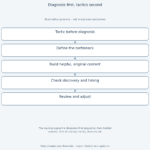
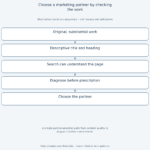
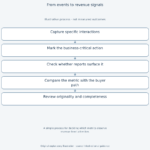
Short answer: A B2B company should make its expertise easy to find, verify and use in a buyer decision. Start with an existing page that answers a specific customer question, add defensible evidence and practical judgment, check search eligibility, and measure citations separately from visits. Improve the answer before publishing another competing article.
What should you take away from this guide?
- Own one buyer question on a suitable existing URL; inspect related pages before adding another article.
- Use evidence, an explicit decision method and honest limitations. A longer generic summary is still a weak answer.
- Treat technical eligibility as a prerequisite to investigate, not a promise that an AI system will cite you.
- Record exactly what changed. Review weekly, but let a useful improvement accumulate observations before rewriting again.
This guide is for founders and marketing leaders at specialist B2B companies who need a practical diagnosis before buying another visibility tool. The recommendations below apply D3 Digital Media’s WAVES framework to that decision. The diagnostic is an editorial method, not a validated ranking score.
What does B2B AI search visibility actually mean?
For your own reporting, define the result you want before calling something “visible.” We recommend keeping these observations separate so a change in one cannot silently become a success claim about another.
| Observation | What to record | What it cannot establish alone |
|---|---|---|
| Company mention | The company name appears in a saved answer to a relevant buyer question. | That the answer links to your site or sends a visitor. |
| Exact-page citation | A supporting reference points to the specific article URL under review. | That every user, location or repeated query sees the same reference. |
| Domain reference | A reference points to your website, possibly to a different page. | That the article you edited earned that reference. |
| Visit and business outcome | A recorded session, useful next action or qualified conversation, with its own source evidence. | That a citation caused the outcome, or that every visit is a qualified buyer. |
Build a small, repeatable question panel around actual buying decisions. Save the exact wording, engine, location, device where relevant, collection time, cited URLs and an answer capture. Keep branded questions separate from unbranded discovery questions. “Does this tool know our company?” and “Which approach should a buyer choose?” test different things. A lone missing citation is a reason to investigate, not proof that an entire channel is failing.
Why might a credible B2B company be missing from an answer?
Start with competing explanations. The intended page may not be eligible for search, may answer a different question, may offer little verifiable support, or may simply be absent from that particular sample. Inspect each possibility rather than treating the symptom as proof of a single algorithmic cause.
Google Search Central says supporting links in AI Overviews and AI Mode require indexing and Google Search snippet eligibility. It describes no additional technical requirement or special AI schema, and meeting its requirements does not guarantee inclusion. See Google’s AI features guidance.
That distinction changes the work order we recommend. If the page cannot be found or fetched, investigate access first. If access is healthy but the answer is vague, improve the buyer explanation and evidence. If the content is useful and technically eligible, collect a consistent sample before making another speculative rewrite.
How can you use WAVES to find the first useful fix?
D3 Digital Media’s published WAVES pillars are Web Presence, Authority, Voice, Engagement and Systems. The table below applies those pillars to AI-assisted discovery; it does not claim that search engines use WAVES as a ranking formula.
| Capability and symptom | Evidence to inspect | First action and separate measure |
|---|---|---|
| Web Presence: the intended answer page is difficult to locate or inspect. | Fetch the public page; check its canonical, indexability and search inspection evidence. Locate its internal entry points. | Fix a verified access or navigation problem first. Record eligibility observations separately from later citations. |
| Authority: the article makes claims a reader cannot check. | Identify the source behind each important assertion: original documentation, a named expert explanation or permitted first-party evidence. | Replace unsupported promises with supported detail or a stated limitation. Record which claims now have inspectable support. |
| Voice: the copy could describe any supplier. | Look for an explicit judgment: which option fits which constraint, what changes the recommendation, and when it should not apply. | Add a useful decision rule or labeled example. Evaluate usefulness directly; do not turn editorial completeness into a citation forecast. |
| Engagement: the answer ends without a relevant next step. | Follow the path from the question to a useful supporting guide, commercial destination or diagnostic. | Choose a next step that fits the reader’s decision. Measure its actual use separately from traffic. |
| Systems: the team cannot tell which version was evaluated. | Inspect the edit history, publication time, query panel and matching performance periods. | Save the old and new versions and an observation plan. Compare search, visits and genuine outcomes without merging their meanings. |
Use the table to choose a bottleneck, an owner and a verifiable next action. Avoid assigning a precise “AI readiness” number unless you have a defensible scoring method. A checklist is useful because someone can inspect it and disagree with the diagnosis; a decorative score does not supply that evidence.
How do you strengthen the right page without keyword cannibalization?
Choose the reader decision before choosing the keyword. List the existing URLs that could reasonably answer that decision, inspect their content and compare the queries and landing pages available in Search Console. Shared wording is a discovery signal; it does not by itself prove two URLs are competing harmfully.
- Write the question in the buyer’s words and name the decision the answer should support. Include the constraints that make the question specific.
- Give each related page a purpose: the main answer, a genuinely different supporting question, or a commercial destination. If two pages serve the same purpose, investigate consolidation rather than automatically expanding both.
- Improve the suitable existing answer in place. Preserve its URL unless a separate, reviewed reason justifies a move. Keep a note explaining why nearby pages remain distinct.
- Link to complementary depth using descriptive anchors. Do not repeat the same generic introduction across every article or force the target phrase into every anchor.
For this guide, AI visibility diagnosis is the central job. A complete technical implementation belongs in the technical SEO strategy guide; broader content prioritization belongs in the performance-led content planning guide. Those are supporting destinations, not sections this article needs to duplicate.
What makes an answer useful enough to deserve attention?
Our editorial recommendation is to build an answer a buyer could actually use in a working conversation. State the decision directly, explain the conditions behind the recommendation, and make its support inspectable. Organize the page so a reader can find the answer without reading an entire sales narrative first.
- Start with an answer: say what to do and the main condition that could change it. Let the following sections explain why.
- Keep evidence near the assertion: link a platform behavior to its official documentation. For a company claim, provide permitted first-party support or remove the claim. A bibliography cannot rescue a sentence its sources do not support.
- Add judgment: compare viable options, name the trade-off, and explain what information would make you choose differently.
- Make examples honest: identify a hypothetical scenario as hypothetical. Do not invent a customer name, quote, outcome or performance chart to make the page look experienced.
- Use structure for the reader: question headings, short explanations, a comparison table or a checklist should clarify the decision. They are not evidence of ranking performance.
Google Search Central’s helpful content guidance asks whether material provides substantial original value, satisfies its intended audience and makes authorship clear. Google also says it has no preferred word count. That supports a completeness review, not a minimum-length promise.
What would this look like for a specialist B2B company?
Hypothetical example, not a client case: imagine a laboratory software consultancy whose services page says it delivers “digital transformation.” Its intended reader is an operations leader deciding how to approach a software migration. The following is an illustration of answer design, not technical, clinical or regulatory advice.
Instead of adding another broad services article, first look for an existing buyer guide. Give that page a specific question: “How should an operations team choose a software migration approach when continuity and evidence ownership matter?” The useful contribution is the decision criteria, not a claim that the consultancy has achieved an invented result.
| Option to investigate | Question the article should help the buyer ask | Evidence still needed |
|---|---|---|
| Phased transition | Which functions could move separately, and what must continue working between phases? | Documented dependencies and agreed acceptance criteria. |
| Parallel running | What would the team compare between systems, and who resolves a mismatch? | A defined comparison method and named evidence owners. |
| Single cutover | What conditions must be satisfied before switching, and what would trigger rollback? | Explicit requirements, verification responsibilities and a recovery decision. |
The example cannot choose an approach for a real laboratory. It supplies questions for discovery, leaves outcomes unclaimed and makes the missing evidence visible. A real article would need the company’s qualified subject-matter input and permission for any proprietary material before adding specifics.
Apply the same discipline to your own market: replace the vague category with a buyer, a choice, a constraint and the evidence needed to resolve it. If that work reveals a distinct question already answered elsewhere on your site, improve or link the existing answer rather than manufacturing a rival page.
What technical and image checks should accompany the rewrite?
Use a publication checklist alongside the editorial review. Check that the public page loads, the main answer is present as readable text, links work, the intended canonical remains intact and no unintended index or snippet restriction has appeared. Inspect actual output after publication, not only the editor’s saved copy.
OpenAI distinguishes OAI-SearchBot, used for ChatGPT search, from GPTBot, used for potential model-training collection. Their controls are independent. A site can permit search crawling while declining training collection. Review the OpenAI crawler documentation before changing those controls; allowing a crawler does not guarantee a citation.
Use an original featured image that relates to the article, with descriptive alt text and suitable dimensions. Compress the delivered file, reserve its display space, and inspect the mobile layout. Do not present a conceptual illustration as a real analytics screen or a customer result. The featured illustration for this guide is AI-generated editorial artwork.
Google Search Central documents Article structured data as a way to describe article information such as title, author, images and dates. Check the existing SEO plugin’s output against the visible page before adding competing markup. Structured data is not a promise of search appearance.
How should you measure the change and decide what happens next?
Write the hypothesis before publishing: a specific answer with inspectable evidence should better serve the intended buyer question. That is a proposition to evaluate, not a ranking guarantee. Save the prior article, new article, featured image association, publication time and the reason for the change so later observations refer to an identifiable version.
Google Search Central says AI-feature traffic is included in Search Console’s overall Web performance data. Those totals alone do not isolate an AI citation or an AI-only visit.
- Search: compare clicks, impressions and click-through rate for the page and relevant query groups over equivalent complete periods. Keep property and page scope consistent.
- Visits: inspect organic sessions and explicitly defined useful actions in analytics. A search click and a session have different definitions; do not force them to match.
- AI samples: repeat the same saved question panel and retain the references. Keep exact-page citations apart from references to other URLs on the domain.
- Business value: inspect qualified conversations and downstream movement using genuine source evidence. Use the B2B revenue measurement guide for the broader commercial discussion.
Review the record weekly. If the page is broken or contains a factual error, correct it promptly. If the experience is healthy but the observation window is incomplete or volume is too low, keep the improvement in place and record “inconclusive.” Avoid resetting the experiment with a fresh rewrite every week. External edits, seasonality and search changes remain possible explanations for a difference; a before-and-after comparison alone does not prove causation.
What questions should a founder ask before approving the next change?
Should we publish a new article or improve the existing one?
Improve the existing page when it serves the same reader decision and can become the main answer. Consider a separate page when it resolves a genuinely different question, then document the relationship and linking plan.
Will more words or an FAQ make us appear in AI answers?
Use extra explanation only when it resolves a buyer question or supplies missing support. The useful test is whether the reader can make a better-informed decision. Neither this structure nor an FAQ supplies evidence that an engine will cite the page.
What if our company is mentioned but our article is not cited?
Record the mention and inspect the references separately. The sample may point to another page, another domain or no supporting link to your company. Choose the next action from that evidence rather than counting a mention as an article win.
When is another rewrite justified?
When a clear content gap, changed fact or adequately observed performance problem supports a specific hypothesis. If the evidence cannot distinguish a problem from ordinary uncertainty, collect more observations and preserve the useful answer.
Sources and editorial method
This guide combines the official documentation linked below with D3 Digital Media’s labeled editorial recommendations. The WAVES diagnostic and laboratory-software scenario are authored applications, not measured client results. AI assisted the drafting and illustration; source checks and a separate editorial review are part of the publication process. The original author biography and assessment destination are retained.
- Google Search Central: AI features and your website
- Google Search Central: Creating helpful, reliable, people-first content
- Google Search Central: Article structured data
- OpenAI: Overview of OpenAI Crawlers
- D3 Digital Media: How WAVES Works
Use the WAVES Kompass to find the bottleneck.
If this question is active inside your company, the next step is diagnosis before prescription.